Friday, August 17, 2007

What is the Weight Loss Mindset?

Weight loss ... easy, right?

Statistically, all it takes to lose weight and keep it off is to "eat less and exercise more". It's just a numbers game, right? When the number of calories taken in each day is lower than the number of calories burned off, you'll lose weight. Doing this consistently each day will eventually bring you to your weight loss goal. After reaching your lower weight, maintaining it then becomes a simple matter of matching the number of calories taken in versus burned each day on average.

Unfortunately, successful long-term weight loss is actually much more complicated in real life. In fact, people tend to horrible at actually pulling off this lower calorie lifestyle--especially over the long haul. So, what is the secret formula for making this happen? I actually have an answer: the creation and maintenance of a respectable eating and exercise routine AND the possession of a strong weight loss mindset.

A successful weight loss mindset is an individualistic combination of commitment, motivation, desire, focus, and vision. So, how does one create and feed such a mindset? Here are a few ideas:

1) list the positive benefits/pleasure you'll receive by losing the weight and review this regularly
2) list the negative consequences/pain that will occur if you don't choose to lose the weight
3) research and write out a number of key positive, inspirational quotes/lines that motivate you to do what you need to do; review them regularly and as needed
4) close your eyes and picture yourself commencing successfully through the day with your healthy eating and exercise plan--and enjoying it
5) close your eyes and visualize yourself already at your lower, ideal weight; enjoy your success before it even happens
6) especially helpful: seek out some quality hypnosis for weight loss from a licensed, trained, and experienced psychotherapist--either live or through audio CDs

In short, put yourself in a peak emotional for weight loss. Give yourself the ultimate advantage. The better and more often you do this, the easier your weight loss journey. I promise. I've been there myself.

Best of success, health, and happiness.

Dr. Randy

Wednesday, August 1, 2007

10 Tips for Eating Smaller Portions

Here are 10 things you can do to successfully eat smaller portions. Research shows that you will generally eat less when you:

1) Drink from tall, skinny glasses (over shorter, fatter glasses)
2) Place food on smaller plates
3) Create meals with less variety (the greater the variety, the bigger the portions)
4) Train yourself to not eat all of the food on your plate (push the plate away with some food remaining)
5) Periodically have someone else dish up your food (a person that supports your diet)
6) Eat slower; chew longer and pause between bites
7) Between bites, take a break and allow your body to notify you when it is naturally full
8) Take smaller bites; place less food on your fork/spoon before you place it in your mouth
9) Switch between eating bites of the healthier foods on your plate before eating the less healthy/more fattening foods
10) Try to give yourself portions no larger than your clenched fist (which equates to the size of your stomach)

Any other tips for eating smaller portions? Please leave them in response to this posting. Happy (healthy) eating!

Dr. Randy

Wednesday, July 18, 2007

Diet Supplements Don’t Work!

Hello Everyone:

Diet supplements don't work. Here's why: they either don't work at all and/or have horrible side effects that are harmful to your health. The few supplements that may temporarily promote some weight loss do so by trying to:

1) Artificially suppress your appetite--leading to malnutrition and your appetite returning with a vengeange when you stop taking the supplement

2) Try to bind and pass excess food out of your body--which strips your body of vital nutrients and promotes malnutrition

3) Try to forcibly accelerate the body's metabolism to burn calories faster--which creates an unhealthy strain on the heart and even heart attacks

4) Trying to get you to buy entire meal plans of lower calorie foods--leading to high expense and lost pounds returning when a person eventually chooses their own foods again

In short, diet supplements are expensive, ineffective, and unhealthy. The best solution? Create your own diet and exercise program based on moderate exercise that you'll actually maintain longterm + create your own lower-calorie diet with foods that you'll actually eat and stick with. Weight loss--that is, long-term, healthy weight loss--comes from a long-term healthy weight lifestyle, rather than through expensive, unhealthy diet supplements and/or foods that cannot be maintained.

There is no easy, quick fix with weight loss. This is a marathon, not a sprint. However, if you would like assistance to kick-start your weight loss motivation and committment, you might want to check out my comprehensive hypnosis for weight loss program at http://www.theweightlossmindset.com/. Hypnosis for weight loss = good. Diet supplements = bad.

Best wishes,

Dr. Randy

Wednesday, April 11, 2007

Old Sayings for Losing Weight

Here are 5 old sayings to help with your weight loss (I can't remember the authors):

*If it is to be, it's up to me

*If you think you can or you think you can't, you're right

*Insanity is doing the same thing over and over again, but expecting different results

*There is nothing to fear but fear itself

*People are about as happy (and successful) as they choose to be


Until next time...

Dr. Randy

Tuesday, April 10, 2007

Self-Control and Weight Loss

Hello everyone:

To lose weight, all you have to do is to eat less and exercise more, right? Right. Well, that's easier said than done. One of the critical components of weight loss success is the principle of self-control: exercising willpower with our eating and exercise choices. This is essential, but most of us are pretty bad at it. So, what to do?

In an recent Psychology Today article named "Baby Steps to Grown-Up Control", ideas are given to boost your weight loss journey through strengthening your self control. The main idea is this: self control is like a muscle that becomes stronger with practice and exercise. If you can practice small, consistent demonstrations of self-control through simple tasks, your control will increase. Stronger self-control in general makes for better eating and exercise choices.

Try these exercises to build the mental muscle that can actually help you diet:

-- Think twice before buying something.
-- Focus on eliminating "um"s or other unnecessary words from your speech.
-- Spend a week or two avoiding alcohol.
-- Try brushing your teeth with your less dominant hand.
-- Remind yourself to sit up straight.

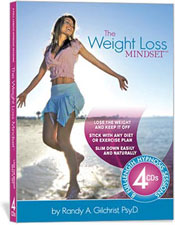
A second idea to boost your mental self-control for better weight loss: my comprehensive hypnosis program for weight loss, "The Weight Loss Mindset".

Wishing you strength, will power, and a smaller waistline.

Dr. Randy

Wednesday, April 4, 2007

The Pressure to Lose Weight

In a recent People Magazine article, Hilary Duff discusses the enormous pressure in Hollywood to lose weight. She expressed that, "I did get skinny...I've felt that pressure like everyone else in my position. When a newspaper comes out that says 'Duff Puff – she must have gained 15 pounds' or something like that, how would any normal person react?"

In Hollywood, actresses are in a constant state of being criticized as too fat ("Duff Puff") or too thin ("Eating Disorder"). Is there any woman in Hollywood that actually is an acceptable weight? It seems not. No wonder eating disorders are so rampant there--and in the rest of the United States!

What does all of this mean for you--and everyone else not in Hollywood? A lot. The pressures of Hollywood are simply exaggerations of the everyday pressures put on all women to be thinner, heavier, or so other "er". One good solution? Look to medical science for what is healthy and ideal.

I suggest calculating your ideal Body Mass Index ("BMI") number to find your true, statistical ideal weight range and make that your target weight range to strive for. Your ideal BMI calculation should be between 22-24.9. When in doubt, trusting in science is a decent way to go. Strive to be medically healthy.

As for the self-proclaimed weight police out there telling everyone they're too ___, I say, who made them the experts? What are their credentials? For the most part, they have none. They're usually not medical doctors, so they should stop acting like it. Even if they happen to be MDs, why would it still be OK to give unsolicited opinions and judgement? Think about it. If weight opinions are unsolicited and critical, they're usually not wanted.

Until next time,

Dr. Randy

Saturday, March 31, 2007

Overcoming Emotional Eating

Hello Everyone:

Have you ever found yourself calm your stress through munching on chips? Have you ever drown your sorrows with a big ice cream sundae? Have you ever escaped boredom through chocolate? If so, you are not alone. We've all done this from time to time. However, these situations needs to be a rare, contained events. If "emotional eating" becomes our usual approach to food, we'll soon need to eat more and more to sooth our panic at our expanding waistlines. We're overweight because we feel bad, and then we feel bad because we're overweight. Yes, it can become a vicious cycle.

As I mentioned in my 12/11/06 post, "The Secondary Gains of Poor Eating", one of the common possible incentives for continuing with poor eating habits is for food to serve as an emotional state changer. In other words, when we don't like how we're feeling, as easy (although temporary) way to try to change those feelings is by eating some "comfort food".

So, how do we control emotional eating? Well, the short answer is to find and swap in a better, healthier way to soothe our upset feelings than through food and eating. Food should be for replenishment and refueling purposes only.

So, here are some other ways to soothe and shift your feelings:

1) Learn and practice healthy relaxation techniques, such as deep breathing, progressive muscle relaxation, visualization, etc. A solid resource for such relaxation is "The Relaxation and Stress Reduction Workbook" by Davis, McKay, and Eshelman (2003). Learn and practice these techniques so that you can go to them as needed when the crisis hits.

2) Beef up your social life. A disconnected, lonely, depressed, and/or angry person is a person at risk for emotional eating. And, nothing puts us at risk for such feelings like our relationships being strained. The primary relationships are, in order of priority: spouse/partner, children, parents/extended family, friends, coworkers/acquaintances, strangers. Initiate contact with these social sources in your life. Repair, nourish, and reconnect with all of the main social relationships in your life, and your emotions will reward you. Call, email, send a card or letter, visit, etc. Apologize regularly. Also, ask for and give forgiveness to others and yourself on a continual basis.

3) Be your own best emotional support system. Be your own best friend. Pamper yourself. Need a break? Take one. Need some better eating, exercise, and sleeping habits? Give yourself these gifts. Need a hobby? Find one and enjoy. Give yourself what you really need in a healthy, balanced way. Remember, if you're not going to treat yourself well, why should anyone else? Furthermore, how or why would you feel good if you don't treat yourself in positive, supportive ways?

There are many other ideas here, but these 3 ideas comprise a healthy start. Enjoy!

Dr. Randy